Croissants – A La Julia Child

As French as it gets, Croissants can (and should) be found on any Continental breakfast plates in all hotels, or pastry stores. A light (as in weight, NOT calories, mind you!) leavened puff pastry also known as a Crescent or a Crescent Roll for its distinct shape, a Croissant is made by many rolled and folded layers of yeast dough with butter in between.

Julie & Julia
In honor of my culinary hero Julia Child and upcoming movie about her life Julie & Julia (where Meryl Streep plays Julia Child, and Julie Powell is played by Amy Adams) I decided to bake one of her recipes from her TV show The French Chef With Julia Child 2 – Croissants.
Although the process might sound intimidating it is in fact quite simple. Hey – if a rookie like Julia could make it, you can make it too! I will go with you step-by step as presented by Julia in her show. Read along – it is fun and delicious!
Julia Child, More Than A Character
As she goes through her rolling pins collection in the Croissants episode of her late 1960′s TV show The French Chef, where she flamboyantly throws one of them in the trash bin, concluding that “It’s good for nothing, I don’t know why I keep it”, or as she encourages you to take heart when you flip anything in a pan to do it with the “courage of your convictions”, while she spills most of her potatoes on the stove top, Julia Child – the pioneer of cooking shows, gives hope for cooking newbies like you and me who feel so small and intimidated while watching modern big-wig cooking shows where everything turns out perfect, manicured and shiny!
I was extremely excited to hear of the Julie & Julia movie and from what I’ve seen of the trailer, Meryl Streep does an outstanding acting in playing the role of this extraordinary woman! Can’t wait to watch it on 7th of August!
Le Croissant
Considered the donut rival in America (and rightly so), the croissant gained quick popularity in every pastry shop, continental breakfast plate, and even in donut chains. Charles Dickens wrote about the Croissant in his 1872 All Year Round periodical, “the workman’s pain de ménage and the soldier’s pain de munition, to the dainty croissant on the boudoir table“.
But it’s humble origins are mentioned long before that year, when August Zang (an Austrian artillery officer) opened the Boulangerie Viennoise in 1838 in Paris featuring the popular kipfel, that inspired the French pastry chefs to roll out a nationalized version calling it Le Croissant, due to its crescent shape.
Le Recipe
As intimidating (and cliche) as it probably sounds - if you can make a humble omelet, you CAN bake a beautiful batch of 12 Croissants. I mustered up enough courage by watching Julia’s episode on how to make Croissants, and being baking a couple of successful batches since then – well, one of them turned out more browner than needed as I left them in the oven too long [ahem!]. The nice thing about it is that the dough can be prepared ahead of time, and frozen so when you are planning on baking, all you need to do is to get your oven going and your appetite. There are a lot of Croissants recipes, I am sure, but just for the sake of celebrating the movie and the women who inspired it, I’ll stick with her version.
Flour Options
Probably the most important step in the recipe is to use the right flour type for this type of pastry. Julia suggests using a low-gluten flour so the dough can be easily rolled without becoming rubbery, etc. You could for instance use a mix of 1 part unbleached all-purpose and 2 parts unbleached pastry flour. She also adds tasteless oil to the mix, to help tenderize the dough.
Yeast Dough
Even if today’s dry yeast has a very small chance of failing to do its job, I will give it a chance to prove itself to be worthy of our croissant dough.
1 Tsp dry yeast
1/4 Tsp salt
1/2 Tb sugar
1/4 cup warm water (not more than 110 degrees, otherwise you’ll kill the yeast)
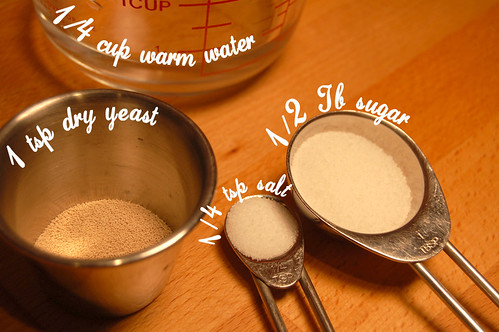
Start by mixing all these ingredients with the warm water until dissolved, and let it sit for 5 min. If the yeast is active (and it should) it will form a soft foamy mass on its surface:

Croissant Dough
No big secret here to be learned. Make sure that when you measure “1 cup of flour” you actually sweep off the excess with the edge of a knife so you will have a consistent quantity. The quantities given here are good for a batch of 12 croissants. I usually double it and freeze a half of the dough (after I have the butter in it).
2 Cups of your flour mix (see Flour Options above).
1 Tb sugar
3/4 Tsp salt
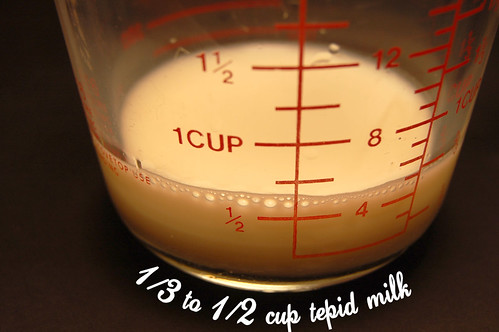
1/3 to 1/2 cups tepid milk
if using unbleached flour: 2 Tb vegetable oil (I used Canola)
if using bleached flour: 4 Tb vegetable oil
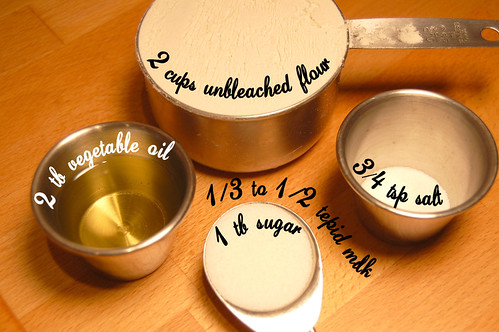
Blend all the above in a mixing bowl (don’t forget the yeast mix) with a spatula into a sticky mass, then out on the board:
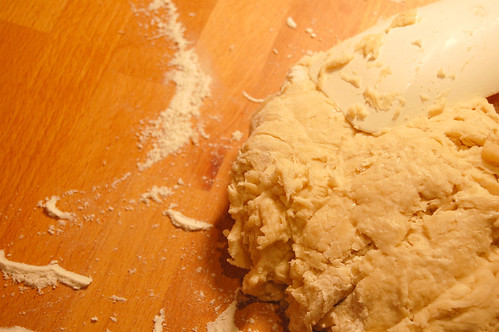
Time for some punching – works well when you are mad. Julia suggests the lift-and-throw motion and as she talks and demonstrates the moves, the dough gets stuck to her pastry scraper and goes flying as she exclaims “Whew!” and goes on with her explanation without any trouble… Typical Julia Child! Love it. Un-edited fun!
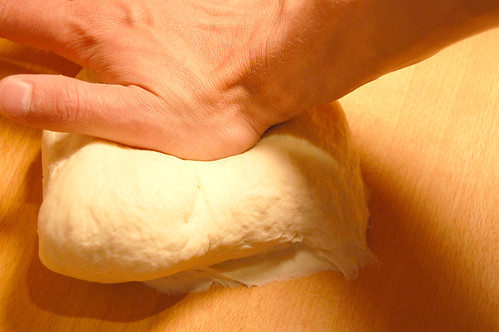
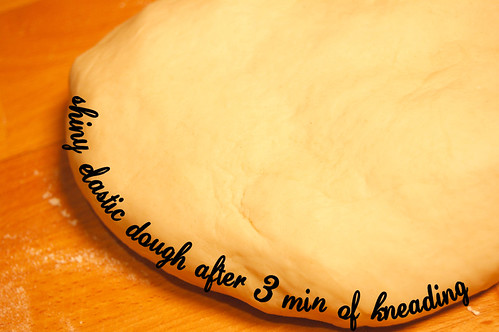
Keep on being rough with your dough for about 3 minutes – it’ll be somewhat sticky at first but after a good rapid fold and knead with the heels of your hands it will become elastic, smooth and will not stick to your hands anymore:
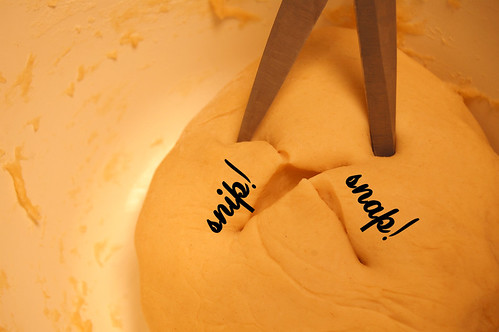
Time to rise. Plop the dough into a bowl and do a criss-cross scissors snip on its surface to help it rise. Then cover it with a plastic wrap, and let it rise until it becomes double in bulk:
Rising time depends on the room temperature. I found that if I do this in the summer, rising is faster than in winter. About 1 to 1-1/2 hours at say 75 degrees will suffice. Don’t keep it in temperatures higher than 85 degrees or longer that needed (over-rise) since that wll impart an unpleasant taste. At this point you can retard the rising by placing the bowl in the refrigerator:
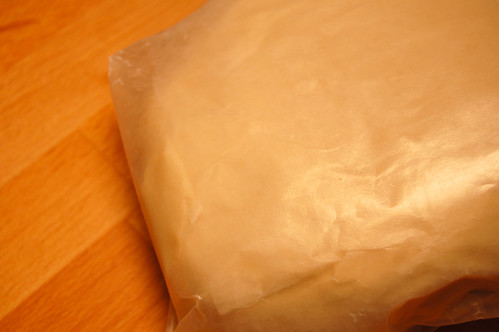
Then, punch it down into a flat circle, wrap it in wax-paper and chill it for about 20-30 minutes. The chilling is important as it makes working the dough much easier:
Rolls, Turns and Chills
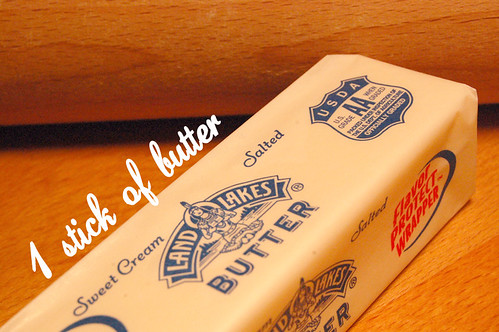
If the croissant recipe would be considered a somewhat complicated procedure, than this particular step would probably be the one that will need more attention. What makes this basic yeast dough (good for bread, etc.) become a croissant dough is a good old stick of chilled butter. It is butter that makes the world turn. And it is butter that will make the 82 dough layers for our croissants:
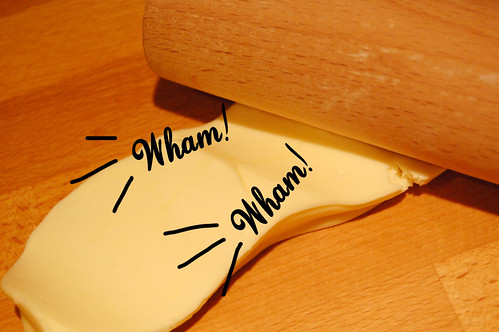
Time is now to beat the daylight out of this chilled butter with your rolling pin. The idea here, my friends, is to work the butter into a malleable consistency, free of lumps and very fast, to keep the butter cold – working with melted butter is just not fun:
Then finish this procedure by pushing the whacked butter bits by bits out with the heel of your hand, so it is completely lump-free:
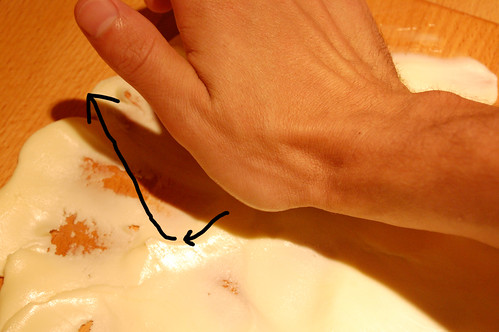
Lovely, huh? Having fun yet? Now, press your dough (I roll it) into an approximate 9″ diameter circle, then form the butter into a 5″ square (square-ish in my case) and place it on the top of your dough (centered):
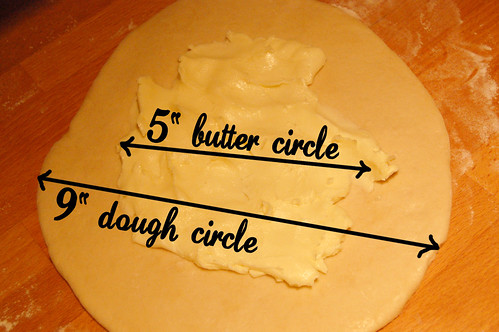
Now gently flip the dough edges (without ripping it!) over the butter and seal in the butter by pinching the dough:
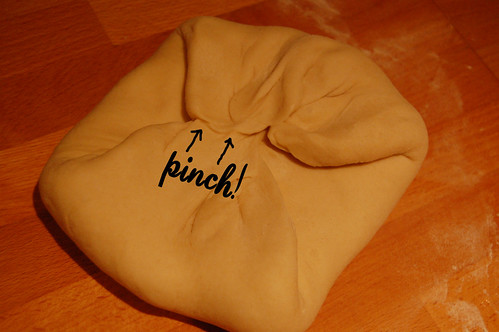
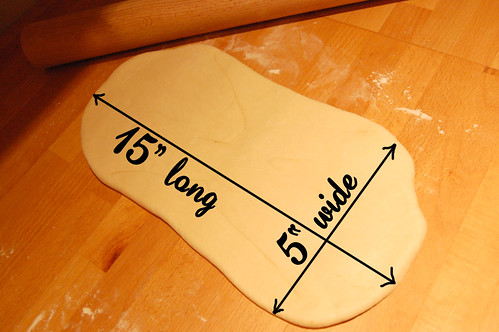
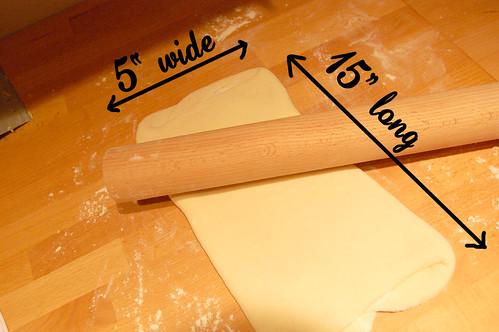
Voila! now you have a nice package of dough with a stick of butter inside, ready to be massaged into many layers. For that, flour your rolling pin and both sides of your dough, place it on your board with the seal side up and start gently rolling back and forth from the center towards the edges to form a rectangle of about 15″ long and 5″ wide. It doesn’t HAVE to be exact, but try to at least get close to that dimension. If there are butter bits that poke through, just pinch the dough over that spot to re-seal it. Also, if the dough became too rubbery (read warm), chill it again for about 20 minutes and continue from where you’ve left it. What you want here is to evenly spread the butter between the two dough layers (this gets you ready for your next step):
Turns #1 and #2
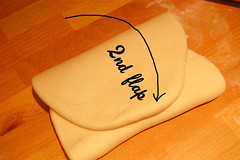
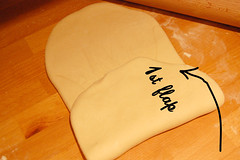
Okay. What’s a turn in culinary lingo? Julia Child defines it as having the dough folded like a business letter in 3 even layers. And really, that’s exactly what it is. Gently fold the bottom of your rectangle to the center of the dough then fold the top flap over it the same way. That’s defined as turn #1:
Then once again, roll out the dough to the initial 15″ long and 5″ wide rectangle to prepare it for turn #2 just as before. Keep the edges as straight as possible (I re-align them with the rolling pin). You will see that it will look more like a rectangle than before. Rinse and repeat – you got it right?
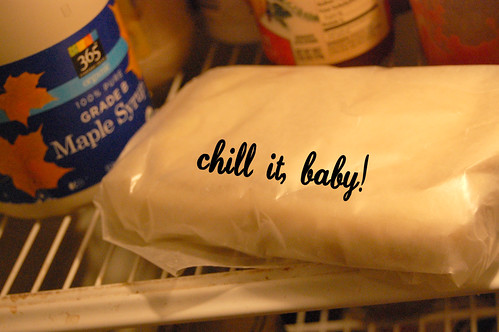
By this time (after turn#2) your dough needs some chilling to be able to roll it another 2 turns. Leave it folded as a business letter, flour it lightly, wrap it in wax-paper and place it in the fridge for about 1-2 hours:
Turns #3 and #4
After the time spent in the fridge (1 to 2 hours) the dough is relaxed and ready for turn #3 and turn #4. Really nothing special here. Just repeat the same process as for the previous two turns – two rollings into the 15″ long and 5″ wide rectangle and two business letter style folding. You will end up with 81 layers of butter between 82 layers of dough. Again, by this time the dough is probably getting to rubbery to work with, so back in the fridge it goes for a 2 hours chill.
Croissants Shaping
After the 2 hour chill, out of the fridge the croissant dough comes and onto a lightly floured board. This time roll it into a 20″ long by 5″ wide rectangle. Try to keep the edges as straight as possible:
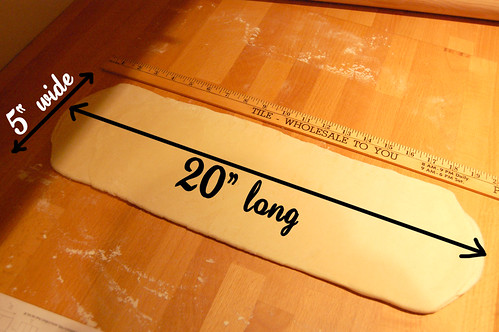
Next, make a middle crosswise cut and chill one half:
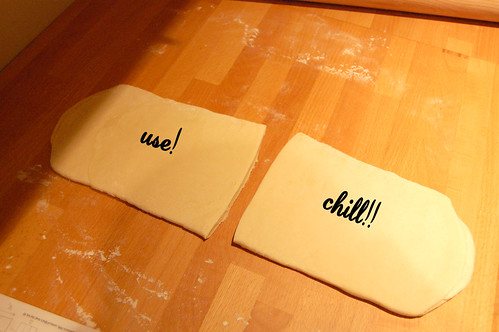
Now, roll the one half of the croissants dough into a 12″ long by 5″ wide rectangle and cut it in thirds and chill two of the thirds:
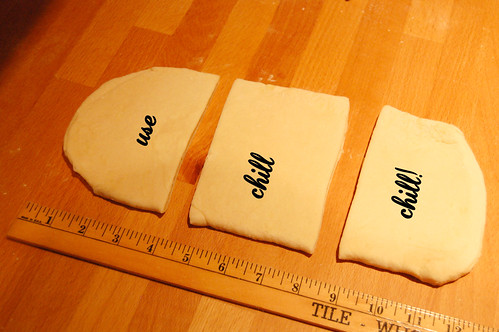
Now take one of the thirds and roll it into a 5-1/2″ square and cut it on the bias. Mine here doesn’t look terribly square-ish but you get the idea:
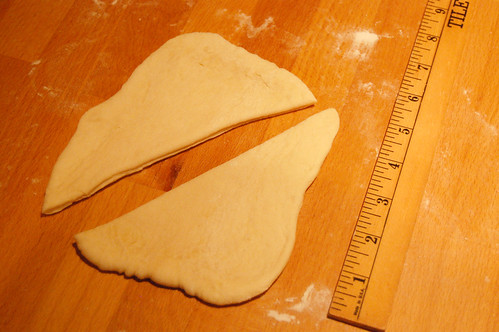
Roll the triangles out to extend to about 7″ long and shape it as much as you can into a isosceles triangle (where two sides are equal in length). Now starting at the base, roll up the dough towards the tip of the triangle, then bend it into a crescent moon form, and place it on a buttered 12″ x 14″ baking sheet (not too close to each other so they don’t fuse together while rising and baking) with the tip of the triangle on the bottom so that it wouldn’t unwrap during baking. Form the rest of the dough the same way into a total of 12 croissants, and let it rest for an hour covered with a plastic wrap. This might be a good time to get your oven going – set it to 475 degrees (mine takes about 45 minutes to heat up). You can freeze the risen croissants for later baking and pop them in the oven while frozen:

Glazing and Baking
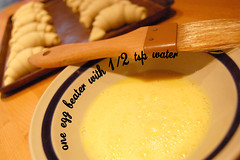
Again, no rocket science here. Simple egg-wash. Paint the risen croissants with one egg beater mixed with 1/2 Tsp water:
Then pop them in the pre-heated 475 degree oven and really – keep an eye on them because they bake very fast. Usually something between 10 to 15 minutes depending on how dark brown you want them to look. Don’t do any other activities during this fast bake – you will forgot about the oven like I did so many times. I tend to leave them in until they turn dark-brown. Let them cool on a rack for about 10 minutes and resist the temptation of eating – the are HOT!:
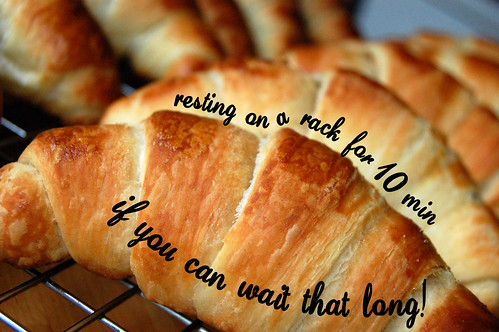
Voila!
Julia mentions in the episode that she could eat Croissants in the morning, for lunch, for dinner, mid-morning or mid-night snack and so on. And I don’t blame her. These evil Croissants are so wicked delicious that can be enjoyed throughout the day. I tend to like them in the morning and for lunch, as a sandwich, or simply with any sort of jam or marmalade. Too bad we don’t have Le Figaro, the French news paper that Julia grabs at the end of the show while sitting down and enjoying her caffé au lait, and freshly baked croissant.

Popularity: 100% [?]


Facebook Page
Flickr Photos Sets
Twitter
YouTube
Subscribe to Mamaliga
July 31st, 2009 10:27
You did an amazing job! I’ve made puff pastry before and though it’s time consuming, it’s easier than it looks. The croissants are gorgeous! I especially love the egg and bacon one. mmm!
July 31st, 2009 10:27
PS, love the step by step photos!
July 31st, 2009 11:08
Elle!
Thanks so much for the comment, and compliments! They also tasted fabulous! The egg and bacon croissant was my wife’s version – lovely I must say.
cheers!
August 2nd, 2009 09:12
Fantastic!!! I loved this post and especially the step by step instructions.
Gabi, I think this is one of your best posts. I am also looking forward to seeing the movie w/Merryl Streep, looks to be a good one. Thanks for this posting, you put a smile on my face and hunger for some croissants in my stomach. Excellent.
August 3rd, 2009 21:28
Wonderful post!!! I love the pictures and all the steps.
August 4th, 2009 08:37
Sam! Thanks a LOT for your comment!!
Wish I would be closer to you – although I bet frozen croissants can be shipped with no problem. All you need on your side is a pre-heated 475 degree oven!
August 4th, 2009 08:38
Erica!
Thanks also for your comment!! Hopefully the step by step guide makes things easier. Enjoy and write back if you have any questions. Cheers!
August 13th, 2009 14:34
This is great! Thanks for the detailed explanation — I’ve always been daunted by croissants but I think I’ll try them now.
Also — I read your blog because I just moved to Romania and like reading about your Romanian recipes too. Fun stuff.
multumesc,
hollie
August 13th, 2009 15:44
Thanks Hollie, for reading my blog!!
I wish it would be more relevant to what’s going on in Romania but I am so disconnected lately.
Where in Romania did you move??
Cheers!
Gabi.
September 4th, 2009 17:02
Thanks for sharing. I love the step by step pictures and the encouraging words. You broke down the recipe in a really no big deal nice way. Thanks again.
September 8th, 2009 17:40
This was my first time on your site, and I am inspired and impressed. The accompanying photos are particularly helpful, and I am aiming to try this recipe as soon as possible.
I do have a question — you noted, “I usually double it and freeze a half of the dough (after I have the butter in it).” At which point in the process is the mixture considered to have the butter “in” it? After it has been folded into the intial pouch-like arrangement with the 5″ butter circle inside the 9″ dough circle? Or can the dough only be frozen once the butter has been integrated into the dough through the various rolls and turns? Or after the croissants themselves have been formed, so that you only need to bake them off?
I am very anxious to give this a try, but I want to make sure I have enough time set aside for it, and would like to see if there are ways to split up the process between a couple evenings. I completely understand if that isn’t feasible, but I thought I’d ask!
September 8th, 2009 22:46
Nora!
I am flattered! And whoa now I have some pressure – once somebody tries out one of the recipes.
Good question. Indeed as you mentioned, I usually double the quantities (to result 24 croissants), and I freeze half of it after turns #3 and #4, right before the Croissants shaping. This way I have a prepared dough (with the butter layered in turns 1 to 4) to be used whenever I wish. All I need to do is to let it thaw for about 30-40 minutes until workable into croissants shapes.
But just ignore that sentence for now if you make only the 12 batch of croissants.
And also – yes – Julia mentions that you can also freeze the formed croissants (after they rise for say 30-40 minutes) and all you need to do next is to pop the frozen croissants directly into the oven at 475 F and keep an eye on them (12-15 minutes until golden brown).
To sum it – yes – you can easily split up the process between say three evenings if you wish or even two. Or a long day for that matter. For instance:
Day 1: Prepare and knead the dough (30 min), let it rise (1 1/2 hour), form it then turns 1 & 2 (15 min), chill (1 hour), turns 3 & 4 then freeze for next day.
Day 2: Thaw (approx 40 min), form the croissants (30 min), let them rise (1 hour), and bake – or optionally, freeze.
Day 3 (optional): Bake frozen croissants directly in the preheated oven (10-15 minutes)
Hopefully this will give you a little direction in choosing how many days to split, etc.
Keep me in the loop, glad to help! – cheers!
October 20th, 2009 20:38
I just had the most delicious croissant so I decided to google for croissant recipes and chanced upon your blog. And I have to say wow this is a gorgeous blog post!!! So much effort! I’m totally inspired =)
October 22nd, 2009 09:29
Mrs Multitasker:
Thanks for the comment! You should give it a try! I checked your wonderful food blog and if you can do all those nice recipes, you sure can do croissants.
November 4th, 2009 21:13
Wonderful!!!! My friend Annie shared a link to your wonderful step by step instructions to making croissants…. THANK YOU for the photos… and step by step instructions! I’m going to give it a GO!
December 19th, 2009 20:40
My husband and I have recently been inspired by Julia Child and are cooking many of her recipes from Volume 1. I was looking for a great croissant recipe yesterday and by chance found your site using Julia’s recipe! Wonderbar! I am thrilled at your step by step approach and I love the details! I will venture to make them tomorrow as we are snowed in and sounds like a lovely project for the last day of fall! Cheers!
December 21st, 2009 10:35
Toni: Thanks for the comment! My pleasure – so, how did it turn out??
Michelle: Julia inspired me in many ways too – she is my culinary hero. What else did you cook from her volume? Let me know how they turned out!
December 21st, 2009 11:46
Hi Gabi! Haven’t tried the croissants yet… want to though!
Right now I don’t have a kitchen… we’re finishing the inside of our new home.. and hope to get sheetrock up this week… well… at least some sheetrock up!
Toni
January 9th, 2010 12:49
Gabi,
Thank you so much for all of your effort on this post! Altough, I am by no means an expert cook, I love making everything from scratch for my hubby and 2 little ones. I actually have bread rising in the kitchen right now!
My husband & I spent our honeymoon on the island of St. Martin (the French side). We ate the most incredible croissants everyday & could not find anything that came even close after returning home.
Just yesterday, a friend who shares my passion for cooking, showed me the 2 Julia Child cookbooks she had received for Christmas. I looked at the croissant recipe & it actually intimidated me a bit. I knew I would certainly try it but “someday”. I decided to try to find the recipe today online & came across your blog. With your step-by-step instructions, pics of what each step should look like & sense of humor, you have inspred me to try them this week. But, I do have a question. I grind my own wheat. So, what I use for baking is actually more of a whole wheat pastry flour with the germ. Can this be used for the croissant recipe?
Thank you so much!
Dawn Marie
January 11th, 2010 12:36
Dawn Marie:
See, comments like these make my (18 degree F in Chicago) day! VERY glad to see that my post encouraged you to give this croissant recipe a try.
I only tried the Croissants with unbleached white flour. Not sure what to say about the whole wheat. I’d say try both (with white and with whole wheat) and see what comes out. The only different thing should be the taste – all else should work the same (raising time, folding, etc.)
You made me curious – let me know of the result! You have a mill???
thanks for the comment!
January 11th, 2010 12:38
Tony:
Hehehe – I think you need a kitchen to bake croissants. A small needed ingredient.
Good luck with finishing the kitchen – I know how hectic that can be – we did that last year.
January 11th, 2010 14:46
Hi Gabi!
Thanks for your reply comment!
We’re sheetrocking the kitchen now… and the cabinets are being made as I write this!
Can’t wait to give your croissants instructions a try in my new kitchen!
Toni
January 15th, 2010 04:33
You are so cute with this “snip-snap” and “splish-splash”!
I’m gonna try baking these as soon as I can, it sounds so yummy..
Thanks in advance for the recipe!
January 16th, 2010 01:47
I’m so glad I found this site…Keep up the good work
January 28th, 2010 22:46
How long do you cook them when they are frozen ?
February 7th, 2010 11:50
This was my first foray into making croissants and I tried to follow your expertly photographed and explained steps. However, my croissants were not light and flaky, but dense and very biscuit-y. The farthest consistancy from croissants.
The only problem I had was that my dough kept expanding sideways when I was rolling it out, and spread far beyond the 15″ x 5″measurement…far enough where I had to fold it again lengthwise because it was nowhere near the shape of a rectangle anymore and do more rolling. I think it might have been the extra folding and rolling out that turned mine into biscuits. Was that the culprit? If so, how do I keep the dough from spreading horizontally when I’m trying to roll it out vertically?
Thank you!
February 9th, 2010 10:28
Flora:
Thanks – let me know how they turned out! Cheers!
Courtney:
Sorry for my delay. Hmm. Strange. What baffles me is the expansion of the dough. I literally need to fight while rolling to get to those approximate dimensions. Specially after the dough gets warm again since the gluten gets developed and tends to hold the dough together.
I think your rolling was correct. The trick I catched Julia Child doing on her episode on Croissants was that she sort of tucks the vertical edges of the dough back with her rolling pin then she gives a couple rolls vertically. Then she does this again a couple of times.
Just curious, what kind of flour did you use? Was that a mix? Did you add the two Tbs of vegetable oil to the mix?
I suspect the flour type you used more than anything else.
Let me know.
February 11th, 2010 09:52
Thanks Gabi for the wonderful demonstration
I tried the croissant twice. I made everything by the book. BUT, my croissant does not come out puffed. It comes out as tough as a brick.
I noticed that after the final rise (after the croissants are rolled) they do not rise to triple the size and they are not light and springy as described by Julia!!
What went wrong ???!!!
February 11th, 2010 19:52
What is the pastry flour?? I used all purpose flour (bleached), the recipe in the book states all purpose flour. Then when I looked at the ingredient chapter, I found an explanation that the french flour can be prepared by mixing, 3 parts of unbleached all purpose flour and 1 part bleached cake flour!! Is that what I am supposed to do??
Or where can I buy the pastry flour that you suggested??
Excuse my ignorance, I am a baking newbie!
February 12th, 2010 15:26
Nano:
What was the temperature of the kitchen/room where the dough was set to rise?
Also what kind of yeast you used? There are chances that the instant yeast was too old and might have dies.
Thanks,
Gabi.
February 12th, 2010 15:32
Pastry flour is usually labelled as “00″ in Europe having very little gluten.
I am using all purpose unbleached and it worked.
Did you proof the yeast? Were you able to get the foamy surface on the yeast/water mix? Also what was the water temp?
g
February 13th, 2010 10:15
Hi Gabi;
Thank you for your instant response.
I am positive that the yeast is fine, It gave the foamy surface, the water was not overheated and the first two rises worked fine (Actually, although in Julia’s book, she stated that the first rise should result in 3.5 the original size, mine did not get that high but it was more than double so I think it is fine.
The kitchen temperature in all rises was 75.
After rolling the croissant, I chilled them till morning and then I left them for 30 minutes at room temprature before cooking.
Let me know, if you have any further suggestions based on my previous responses.
If not, I will try it one more time next weekend and let you know what happens.
Thank you so so much for your feedback
Nano
February 13th, 2010 11:06
Thanks for the response Gabi!
I used the combination of unbleached regular flour and pastry flour, and I did add the two tablespoons of oil. The pastry flour was a little sketchy for me though, because it was whole wheat flour (it was all Whole Foods had) and I wasn’t sure if that would change the consistency of the croissants. Maybe it did. I’m going to try again with just regular unbleached flour.
I’ll let you know how the second attempt goes!
Thanks!
Courtney
February 16th, 2010 11:05
Nano:
After you formed the Croissants, did you leave them to rise for about 1 hour or so?
Also I suspect you went through all the turns ( 1 to 4), right?
Courtney:
Definitely the whole wheat changes the texture. Try using King Arthur’s all purpose unbleached flour. You can find that at Whole Foods.
Let me know how it turns out!
February 16th, 2010 19:39
Hi Gabi;
In my first trial, I left them to rise for an hour and half at room temperature. In my second trial I left them to rise in the fridge over night and I put them at room temperature for half an hour before baking.
And, No No, I would not cheat
I made turn 1 and 2 then I chilled the dough (after this chilling it does not inflate though!!) then I did turn 3 and 4.
Do you think, maybe I applied too much pressure to roll the dough to 15 by 5 or this is irrelavent?
February 17th, 2010 12:14
Nano,
I don’t think pressure can overcome the rising power of the yeast. Time is of essence in rising but it sounds like you had those down perfectly fine. Did they grow after you shaped them into Croissants?
I am starting to suspect the flour type. You mentioned that you used bleached. What brand was that? Did you add the 4 Tbs of oil to that?
Also this worries me: “After rolling the croissant, I chilled them till morning and then I left them for 30 minutes at room temprature before cooking.”
Where did you chill the dough – fridge or freezer? I think you should have give them at least 1 hour of rising time after that chill to get them to puff up more.
If you feel like trying again, try doing that – letting them to rise at least one hour on the tray that will go into the oven. Let me know.
February 17th, 2010 13:33
Thanks Gabi for your instant feedback!
I used pillsbury bleached flour but I used only 2 table spoons of oil not 4!
I chilled them in the fridge not in the freezer for a slow rise. Actually, they did not rise much !!
I bought unbleached flour and I will try again on Saturday(hopefully). I will let them rise for an hour in room temperature and I will let you know what happens !!
February 21st, 2010 09:32
how much yeast in the croissant mix? thanks for the time you put into helping us.
February 21st, 2010 22:51
Hi Gabi;
I tried the croissant again yesterday and they came out much better!
I guess it was the flour, this time I used half a cup of cake flour and completed the rest with unbleached all purpose flour !!
Thank you so much for your help!
February 22nd, 2010 15:40
Nano!
You are a trooper! I admire your persistence! You inspire me! Next time try using completely unbleached flour and see if it improves more. Thanks!
February 22nd, 2010 15:42
My pleasure, Aaron – I used 1 Tsp dry yeast for the recipe I have in the post here. You can go up to 2 Tsp.
February 26th, 2010 13:48
I’m in the midst of this recipe and so far so good. They’re on their last round of chilling. Next will be the final roll and cut. I’m excited to taste!
March 6th, 2010 01:03
the website is actually a link to the photo i took of my finished product.
as you can see i got lots of nice flaky layers, but i think i forgot to do the last turn, regardless, i’m still happy with the overall LOOK of the product.
i was a little suspicious of your recipe because 475 seems very hot and for not very long time. i was right, the insides were still doughy and not fully cooked. i turned the temperature down to 450 and back in the oven for another 10, still not completely done in the middle but whatever. just a note: other julia child croissant recipes suggest 350 degrees for 12 minutes, a rotation and then another 4-6 mins. i will try this baking method in the future.
also, the final product came out tasting very yeasty, at least the undercooked parts did but maybe that’s normal. perhaps i did not let it rise for long enough? or maybe the rolls were simply too thick.
also, i had some issues with the dough. i used all purpose unbleached flour (chat forums on chow.com suggest that AP flour is just fine for croissants, but i am curious to try this again with pastry flour) and all of the allotted liquids, and my dough was kind of well… dry. not crumbly, but it was nowhere near as sticky as it looks in your photos, even from the initial turn out onto the board. i’ve questioned whether this is due to humidity or ingredients… still playing with it… next time i will use more milk. so the dough was smooth after kneading but when it came to rolling in the final turn it began to tear/split and i kept finding butter on my board. which is why i just went ahead rolled it out and cut instead of doing the final turn (did i do the final turn? i cant even remember now)
so all in all, they look gorgeous but taste a bit yeasty and the temperature is suspiciously high. also, the dough was a bit dry for me, but i also had an issue with another croissant dough i tried so it may be the altitude or humidity where i’m at.
thank you so much for the awesome instructions and photos which make a huge difference!
March 9th, 2010 11:45
Seev!
Thanks for the comment – please keep me posted on the outcome!! Cheers!
March 9th, 2010 12:04
Very nice croissant there!! Looks like what I am pulling out of the oven! Congrats!
Interesting what you are saying with the temperature – I followed her indications from her show and I guess I stuck with that. But I see no problem in baking them at a lower temperature, and slightly longer. The thing is, I have a very old oven where the door doesn’t close all the way like on the new ones, so it might be that there’s some temperature loss that brings my temp down to 450F. I’ll try the 350F next time also. Good point!
Yeasty taste, and size. Yes, I admit I detected an yeasty taste in mines also. I always strive to make 12 Croissants out of a batch. That division ensures a cute smaller size Croissant that cooks through every time.
Dough consistency. It might be the humidity in my air indeed, and/or the flour type I am using. I also found differences between flour brands – I am using Ceresota. I tried a batch with an Italian “00″ (lower gluten content) type flour and even if the dough was workable, etc., it wasn’t that chewy – thing that some like but I kinda enjoy some gluten formation in it.
For the sake of a workable dough I’d juggle with the water content just a little. Some flour types absorb more water than other ones.
Try it again with the changes you mentioned and keep us posted!
Thanks again!
March 14th, 2010 16:27
Hello!
Thank you for your step by step instructions! I’ve been looking for a croissant recipe for some time and this one looks delicious. But I do have some questions for you.
1. I need to make 14 for my class at school. Is there a way I can make them smaller instead of doubling the recipe?
2. Must I use another flour with my all-purpose flour? If so what kind? Is cake flour an option?
3. For the 2 hour chill before you roll them, can I chill them overnight instead, or would that effect the outcome?
Thank you soo much for your time!
March 15th, 2010 10:54
Hi Lulu! Thanks for the comment and compliments!
1. I would use the same quantity but somehow divide the dough into two (after the folds), roll them and make 7 triangles out of each one. You’ll have to improvise with the triangle geometry a little to get 7 out of each half, but it should be doable.
2. Not really. Julia mentions a mix of cake flour and all-purpose in the show (1 part all-purpose, 2 parts pastry flour). For the first time I used all-purpose unbleached only with the 2 Tbs of veg oil.
3. The overnight chill in the fridge will actually enhance the flavor. I did that many times. It is the rule of thumb with almost every leavened dough (pizza, bread, etc.)
Let me know how it turned out!!!
March 24th, 2010 20:22
Thanks for responding Gabi! I mad the croissants the day I posted my last comment and I just used all purpose flour. They came out good! The only thing I would change next time would be to put more salt than I did. I didn’t put the measurements of salt you had requested because I didn’t think it would need that much with the butter. I was wrong. We ended up putting butter on them! haha Another thing I wish I knew was that my oven has a super hot spot because after I put them in they were looking fine and then I smelled something. They looked fine on top but were burnt on the bottom. But it was okay because with my mom’s help we scraped the bottoms of those croissants and then they were fine. They were a hit in my class! Thanks again!
March 26th, 2010 11:21
Lulu4me:
That’s great news! More butter on the croissants? Won’t hurt a bit! Lol… Yep – hot oven spots are evil. You might want to tame that down by popping in a baking stone on each rack. Don’t buy the expensive ones – use Alton Brown’s advice, go to your local construction materials supply and beg them for two stones. It will help tame your oven.
May 2nd, 2010 07:54
Hi Gabi,
I start making these beautiful croissants last night and now I am baking them. they smell yummy! I can not wait any more! thanks for the recipe and keep up the good work! I just found your website actually about a month ago but I made almost everything that you have posted so far.
Regards Milad
June 13th, 2010 07:59
Heya Gabi,
I’m Nora – writing in from Singapore. Room temperature is close to 90˚F / 32˚C here.
You’re post comes in as a GREAT help. I tried making the croissant as per your step by step instructions. I ended up with 9 pieces. Baked 2 and froze the rest. Will be baking the other 7 on Tuesday. (Today’s Sunday).
The 2 tasted fantastic. After Tuesday’s baking. I intend to make them again, this time round, twice the recipe, and in bigger pieces. My question is, with double the recipe, eg 4 cups flour, 2 sticks butter, etc, will I need to proof them longer than 1 and a half hours? (The step after “snip” snap” with scissors). If so, for how long? Also I find that after shaping the dough into croissant shapes and leaving them for 1 hour, they did not rise so much (like Nano).
I’m using unbleached flour all the way. Will using 3 tsp of oil (per 1 recipe) make the croissant more flaky? Would really like that.
Please advise.
Looking forward and will keep in touch!
June 17th, 2010 13:22
Nora! Thanks for writing and fur trusting my Croissants recipe!
I would proof the same amt of time considering that the yeast’s action works the same regardless of the dough mass. On using 3 Tbs of oil per recipe, I suspect it will add to the flakiness indeed. Let me know how the next batch turns out.
This is great info for me – having an army of you out there test-proofing my recipe!!
July 22nd, 2010 19:03
OMG!
these were amazing..i absolutely love love love this recipe! and thnx to whoever wrote it for all the detailes in thr process =D
although time consuming these are definetly worth it!!! the smell when their in the oven is simply wonderful!
July 26th, 2010 10:57
Isabel – Glad you liked it!! So were they delicious??
July 31st, 2010 05:27
You’re a doll.
August 4th, 2010 10:00
Thank you Denya – Hahaha – that’s an expression that’s used typically in Romania – I am familiar with it. But I assure you – I AM REAL! Thanks for the comment!
August 9th, 2010 22:24
I used rapid rise yeast is it still going to work?? Also when it calls for 1 stick of butter….Your meaning 1/2 cup of butter right?? Just wanted to make sure I’m using the right amount for this recipe since I’ve always wanted to make croissants but just been to scared to go through all the steps and have it not turn out!! Since I doubled the recipe does it mean I need to roll out the dough bigger or keep it the same size??? One more question My oven seems to cook things really fast and uneven should I put my rack up higher and cook them at a lower temp?? Or maybe use parchment paper.
August 16th, 2010 11:14
Chov, it will still work but the flavor will not be there as the rapid rise yeast eats the sugars very fast. Yep, 1 butter stick or 1/2 cup. I would recommend doing a single batch at first instead of double. You learn a lot on the first batch. I would still roll it as a single size instead of a double – takes up too much counter-space and muscles. Plus you’ll end up fighting with the dough as it becomes too elastic as it slowly warms up. The parchment paper will only help to not stick. I would use the middle rack and keep peeking in every 5 minutes or so, plus rotate the tray once for even browning. It really helps to know your oven and its hot spots.
August 18th, 2010 08:59
Well.those photos are amazing…absolutely wonderful, though seem DIFFICULT to make, am a big fialure in baking especially recipes requires rising,,,,my dough never rises:(((
any way I loved that movie,brilliant as much as i loved your blog.
August 18th, 2010 10:54
Thanks Nesrine! Thanks for commenting! Your dough never rises?? That shouldn’t happen. What are you doing wrong? Should be a simple process. What type of yeast are you using? Also what temperature do you have there when you rise your dough?
October 25th, 2010 04:51
oh me oh my this looks tasty. I’ve always wanted to try her recipe but never had the chance to. This gives me confidence
October 25th, 2010 05:25
foarte faine croissante mi-au iesit urmand reteta de aici! si ce miros iese din cuptor cand le coci…. felicitari pentru blog, pozele sunt clare si lamurioare , comentariile haioase te fac sa crezi ca totul e simplu ca “buna ziua” , desi croissantuil mi se parea mie piatra de incercare in patiserie …. dar uite ca mi-au iesit! multumiri si spor la treaba in continuare
November 16th, 2010 14:28
i’ve tried the recipe but it didn’t work for me! maybe i used much flour… and when i put the butter it was very limpy so i added like 2 cups of flour again… and when i had to roll them in order to shape the croissants they didn’t ressambled the once in your pic… It was soooo hard to do… =( can you maybe tell me what did i do wrong? =D
November 19th, 2010 00:33
After one try and thinking I was a failure, I tried your recipe.. and its amaizing. I love the step by step pictures and istructions. Tres bon. You just gave me some confidence in me
November 21st, 2010 20:52
I was so pleased to find a reasonably easy recipe for croissants when i came across this one. Although I think I messed up at the butter step. When you did the butter and rolled it, could you see the butter through? I think I may have rolled the dough too flat before adding the butter, making it too thin. I will try again though! Thank you for sharing the wonderful recipe
December 20th, 2010 15:04
Andreas – sorry to near that. Not sure what to say. Too many things might have gone wrong. Did you use regular unbleached flour?
December 20th, 2010 15:06
Yennifer — glad to hear! You are not a failure even if the croissant recipe might fail! thanks for the comment!
December 20th, 2010 15:12
Tammy – I could see bits of the butter (small ones, like 1/4″ or so). Use a ruler to measure the first rolling (9″ diameter). Also I thing the folding of the dough over the butter and pinching (sealing) is important.
December 25th, 2010 19:10
My first try at getting the yeast to rise failed. I think because I put in too much salt inadvertently. Then, the second time the yeast sort-of rose but when I set it to rise, it didn’t do anything. I threw the blob away and started over. This time, I excluded the salt in the yeast, measured the temperature of the water for the yeast to 110 degrees and put a little more sugar in. I also used a half cup of milk (I used soy because we are out of cow milk). Third time was a charm and everything else went really well. The rolls came out great. Thanks for the great pictures and explanation. Super — thanks!
December 26th, 2010 13:02
Ahh…. help. My dough was waay too sticky to work with. I kept adding flour till I could. It proofed lovely, butter smoothed out great, but when it came to folding and rolling out, the butter kept coming thru! I ended up with a butter mess all over the place. Tried pinching to keep it in, but as soon as I would try rolling, out it came again!
This attempt ended with my dough kissing the trash can. But I’m not done, not by a long shot.
December 27th, 2010 13:01
Hi Jed. Thanks for the feedback and congrats!! I suspect that the first two times you might have killed the yeast with the high water temperature. Is your thermometer calibrated? The water for the yeast proofing should be luke-warm. Try using say 90-95 degrees F water.
December 27th, 2010 13:04
Christian. Sorry for the problems. Let’s see. What type of flour are you using? Are you chilling the dough before adding the chilled butter for 30 min? Also chilling between each turn? I think there lies the secret of success. Let me know.
December 28th, 2010 12:15
I was very intimitated by the cookbook version of croissants, but your pictures have given me hope. I’ll let you know how it goes
January 1st, 2011 06:53
Hey there, tomorro morning Im gonna try bakin these lovely croissants! not for myself, but for a lovely gentleman! I am a great cook, but not a baker
Please, tell me one thing: how much is one STICK of butter? In supermarket they are not even sticks, but 250g rectangles! How many grams do I need for this recipe?
Thanks n wish me luck pls:)
January 1st, 2011 19:39
Hi Gabi-
Awesome post. THANK YOU for the step by step photos-most helpful! I’ve made criossants by another recipe but had waaaaaay to much butter seeping out of my finished product(yuk). I’m looking to try your recipe posted here.
I do have 2 questions: 1) Can I use high gluten flour (aka bread flour)? 2) I assume that a cinnamon sugar mix sprinkled prior to rolling into cresents will have no deleterious effects? I’d like to make these tomorrow & send my hubby off to work with fresh cinnamon croissants on monday.
)
Thanks again & Happy New Year!
January 16th, 2011 21:19
These croissants look delicious!! I was just want to make these so bad… but I just wanted to ask if pastry mix could be used in replacement of pastry flour. Is there a difference between the two?
January 19th, 2011 14:16
1 stick butter = 113 grams, so cut the 250g block in half
Post-making note: sprinkling cinn & sugar tasted great. Some recommend spreading the “turning process” out over days to allow a better flavor to develop as the dough ferments. This works well for pizza dough, so I’ll bet it works for this too. Will do next time.
January 27th, 2011 12:24
Thanks for sharing the detailed steps by steps method and the recipe. Now, I have more confidence in trying out the baking of croissants after reading your post. Thanks again.
January 31st, 2011 07:48
A ginormous thank you for this. Will try this this week!!!
April 23rd, 2011 16:15
I love your photos and labels! I recently tried making sourdough croissants with pretty good success. It just takes longer rising times, which is an opportunity to anticipate the arrival of buttery croissants! I think the sourdough flavor doesn’t really compete with the butter anyways, so they don’t taste much different.
http://transportedtastes.blogspot.com/2011/04/sourdough-croissant-adventure.html
May 2nd, 2011 22:36
Hi, those photos are really helpful! This was my second attempt at making croissants and although the results were much better than my first attempt i still had some problems. When doing the turns my dough was expanding sideways as well as vertically so i had to keep folding the sides back in to keep it recatangular, also when finally shaped my croissants didn’t rise much at all, certainly not triple their original size. I used unbleached flour and the right amount of oil. I checked my yeast before i used it and it is definately still active (i made pizza dough about a week ago so i knew it was ok anyway). I’m sure i didn’t kill it by overheating. I didn’t cheat with the turns, and i let the croissants do their final rise overnight in the fridge, i then left them out in the kitchen for a good 2 hours to get rid of the chill. What i ended up wth was something inbetween cake and croissant. I think the layers are actually ok, the problem was they croissants didn’t rise enough to get air inbetween the layers (i think). Should i use more yeast? i only used 1tsp as in the recipe and i did make 12 croissants out of the recipe.
June 19th, 2011 16:47
I don’t know why but I can’t get past the butter package. Every time I try to do the fold and roll it just falls apart. So I guess I need a lot of practice! Any suggestions?
August 11th, 2011 21:25
Love, Love, Love the step by step direction and pictures! Made them and they were delectable. My family, who are impossible to please, loved them. Thank you for posting this!
August 12th, 2011 12:38
Holly! Glad to hear this! My pleasure!! I need to make a batch these days as weather is more forgiving lately in Chicago.
August 14th, 2011 17:11
I’ve always been scared of making croissants. But my husband just got back from Brasil — a few pounds heavier and he said it was all due to the lovely baked goods they have – the more he described how delicious they were (and they were all homemade) the more i wanted to try to create that good smell he was describing in our home. Anyway, i found your recipe and it has taken me all day but I am to the point of putting them in the oven and wanted to thank you for making this such an easy process. Your pictures and instructions are great! Heres looking forward to that first warm buttery, flakey bite.
August 15th, 2011 11:10
Cathy! Thanks so much for writing! Glad to hear that my blog post inspired you. Please let us know they turned out!!
August 19th, 2011 10:06
What a fantastic post! SO informative … and I loved the part about croissants being light in weight, not calories
August 25th, 2011 13:27
Thank you for this excellent post!
I have a question that shows what an amatuer I am but i need to know> when you cover the dough in plastic wrap to let it rise do you cover the bowl that the dough is in or the dough itself?
August 26th, 2011 09:51
Gabriella – only the bowl. Also make sure you spray the surface of the dough with oil spray otherwise it will stick to the plastic wrap. Hope it helps!
August 29th, 2011 22:15
FABULOUS directions – you’ve brought a complicated, intimidating bread to those that want to try it. Thank you SO much! I’ve bookmarked this amazing blog post and buzzed!
August 29th, 2011 23:35
Gabi-
This recipe is absolutely AMAZING!!! Thank you for the post, my family loved the croissants and are requesting then for breakfast almost every morning now. Definitely going to make a large batch and freeze it.
September 1st, 2011 06:42
I am going to visit my little sister soon and i really want to bake these croissants with her, she loves these kind of activities. The problem is I am a measurement maniac and I don’t know how much a cup/ a tsp/ a butter stick is in grams. Can you please help me with that? I really want to make them perfect.
September 9th, 2011 14:10
Thank you for the great step-by-step instructions and the clever photos. I just returned from Paris, and am depressed by the lack of a decent croissant in Chicago. When I screw up my courage, I am going to try this recipe.
September 14th, 2011 09:39
Sounds good! Hopefully this croissant will be close to what you’ve tasted in Paris!! Let me know!
September 17th, 2011 21:16
What a great post! So happy you put in the information about how/when to freeze- that helps save time and is so convenient! I love the pics and am excited to try this, thanks!
September 18th, 2011 12:57
Just stumbled onto your site. I love it! Great photos, very clear instructions and your croissants look delicious. Will definitely be using this recipe. Thank you!
September 20th, 2011 11:23
Just had the best almond croissant at Renaud’s in Santa Barbara and was inspired to make homemade croissants. Found your blog through random google search and gave this recipe a try the same day. thanks so much for your post. I appreciated the background information on croissants and Julia Child’s recipe and your step by step instructions with photos for every critical step. It was a breeze following. I used 1 part unbleached all-purpose flour and 2 parts whole wheat pastry flour. I don’t think I let my croissants rise long enough before sticking them into the oven because even though they came out soft, the layers didn’t quite separate. From previous posts, I dropped the oven down to 425 so maybe that affected the baking too? not sure. regardless, the flavor turned out wonderful. I stuffed a few with semi-sweet chocolate and they were the best!
September 20th, 2011 20:57
I followed the receipe, made great tasting croisssant…..but…the bottoms burned. WHy? I mean burned not just brown! the top was perfect!! is it the cooking sheet?
Thanks
September 22nd, 2011 09:26
Ali – it might be that you are too close to the lower burner. Can you place the tray on the upper oven rack? Also having a pizza stone in there helps… That plays the role of a heat buffer.
September 22nd, 2011 09:39
Thanks so much for the feedback! I will have to stuff some chocolate bits in my croissants one day. There might be several issues with the croissants turning out soft and the layers not separating. One reason might be the rising environment temperature. If it’s on a hot summer day (80F degrees), the dough rises violently after the 1-1/2 hours. If colder, then it might need a longer time.
I don’t think loosing those 50F degrees played a major role… My only advice is to try the recipe again, and note everything you made differently. I might be able to troubleshoot. Also did you use active dry yeast or instant yeast? Try active dry yeast. Here’s a discussion on several types of yeast you can find in the stores – might be useful: http://www.wildyeastblog.com/2008/01/12/instant-yeast/#yeast-conversions
September 25th, 2011 16:17
Hi!
I came across your post a few days ago, I was fed up of spending £2 a day on croissants! Tried it this afternoon, absolutely brilliant, perfect texture, even if the shape is a bit off :-S Practice makes perfect I suppose!
Thanks for your great post.
Emily
September 26th, 2011 09:51
Emily – thanks for the comment! Wow – £2 for a Croissant?!? I can bake a batch of 12 for that price!! Thanks for the feedback!
September 26th, 2011 15:31
Hi
Thank you so much for the step by step instructions and the pictures. They were really helpful in taking off the ‘fear’ associated with the long procedure
.
Really great post!
September 27th, 2011 01:29
wow! this tutorial is so good and ur croisants are so tempting that it makes me want to join Daring Bakers… just that Im not that daring…
October 2nd, 2011 21:07
Gabi,
You’re such an inspiration! your instructions are very simple to follow so I may give it a try next weekend…I can’t believe that you posted this recipe 2 years ago and you’re still responding to people’s comments.
October 3rd, 2011 11:14
My pleasure Rajani! Glad to hear it helped!
October 3rd, 2011 11:15
Sarah – it’s really an easy recipe after you’ve done it. Try it out – it’s WORTH!
October 3rd, 2011 11:22
Thanks for the feedback Heba!
Let me know how it turns out. I am actually learning A LOT from people here who are posting so it’s all worth keeping a conversation going…
October 21st, 2011 01:36
Hi Gabi, thanks for taking the time to compile this wonderful recipe. I like the fun way in which you present your pictures, makes me more inclined to try it.
I had a question though – I don’t live in the US and I can only get butter in multiples of 100g (while 1 stick is close to 115g). I was thinking of doubling this recipe and using 200g butter for it. Have you ever tried using different ratios of butter, and if so how has the end result been affected by it? I ask because in the multitude of croissant recipes on the internet, the butter content has been the most variable factor, with some recipes asking up to 1 lb of butter for 1 lb of dough!
Also, if I were to chill the dough in the fridge overnight, should I do it before or after making the folds?
October 21st, 2011 23:53
Thanks for the tutorial!
I tried this recipe yesterday and they came out semi-successful. They baked up nicely, but like some had commented, the bottom was burnt, top was perfect, and inside was slightly doughy. I’ll try a lower temperature for a longer time next time and maybe move the rack up a notch.
I have some questions though.
- when kneading the dough, it was always sticky to my hands. Eventually it stopped sticking to the counter but still all over my hands and it did not look as smooth as yours did. Either way I continued on with in and it rolled out fine but I was wondering if I was doing something wrong.
- all the turns rolled out nicely but at the very last step where we roll it out to cut (before shaping) my dough kept shrinking. It shrank to the point where the first 2 I tried to shape were completely deformed. The triangle became a stick. Because of this, I increased the sizes of the croissants. Your recipe calls for 12 croissants, but I ended up with 8. Where did I go wrong? Did I roll out the turns improperly making them so elasticy?
Thanks in advance for any tips you may offer!
October 28th, 2011 01:25
Ps. Just ate them with jam and cream- super delicious, might add a bit more sugar next time though
THANKS
November 12th, 2011 22:28
Thank you for this amazing post! I’m trying my hands at croissants for the first time today, and your beautiful step-by-step instructions made the whole process a lot easier. One question, though: how do you turn the dough triangles into such cute, fat crescents? I followed all of the measuring and shaping directions, and my rising croissants look, well, terrible! They’re long and thin. I know it’s my first attempt, but any tips?
November 16th, 2011 12:48
Hi Rhianna – Thanks for the comment. I believe I make them smaller. More like a triangle that’s 4″ at the base (from where you actually start rolling), and about 5″ long (if you measure from the base to the tip of the triangle). I also would suspect that there’s something to do with the rising time. The croissants should come out fluffy-flaky-insanely plump.
November 16th, 2011 13:12
Thanks Hana! I like moderate sweetness – but sure why not! You can try more sugar. Shouldn’t hurt.
November 16th, 2011 13:27
Hi Lynn – Definitely move the sheet up higher so you prevent burned bottoms. It will help to have a pizza stone in your oven on which to place the cookie sheet – this way you’ll have some heat buffer.
With the sticky dough – yes that should be fine. The more you knead it, the more the gluten mesh develops and the dough will become less sticky. Be violent with it.
Yes – you will have to battle elasticity no matter what. That’s why is so important to chill the dough and work it while is chilled. The more you work it (roll it), the more it will heat up and start shrinking. Try to make up for the triangles dimensions so that you have a 4″ at the base and about a 5″ height from the base to the top. I would shape the triangle into the croissant form immediately after it’s rolled so they won’t shrink. Do a couple of batches and eventually you’ll get to be an expert. Also try the pastry flour next time, that has less gluten content and the dough won’t be so elastic.
November 16th, 2011 13:51
Hi Pawan – I didn’t tried using other butter ratios but I don’t believe having 30 grams less (if you double the recipe) would hurt. The chilling would be before making the folds and in between the folds. Chilling will help you roll the dough – otherwise it would be too stretchy. Let us know how it turns out!
November 16th, 2011 20:52
Gabi,
I just want to say thank you! I have tried this recipe twice. Once with bread flour and the other time with pastry flour. It turned out that pastry flour makes the world turn around for my croissant. So. Good. Though my egg wash was too concentrated and resulted in a slightly harder shell, it was still very very good.
Thank you for the instructions with all the pictures. They do help a lot. And you are so sweet for replying to everyone’s comment
November 19th, 2011 10:30
This is a beautifully done recipe/blog. I’ve been cooking French food professionally for 10 years and it is nice to see a recipe so well explained/photographed. Thank you so much for your time and effort!
November 19th, 2011 11:50
i love this recipe, made it 4 times already, thank you
December 1st, 2011 13:28
Hi Gabi,
Lovely step by step Demonstration and your photos and comments in it made it more lovely.I was searching for croissant recipe and landed in yours. I made mine today ( Preparing from yesterday) and it came out pretty Good
))) Thanks a lot for a lovely recipe and i’ve also given the link of yours to my friends in my Facebook page( not a recipe one). Once again Thanks a lot and Great Job. Keep Rocking!!!
December 19th, 2011 06:41
This is a great recipe description/blog. I have been wanting to make my own croissants for so long, but always been a bit scared, as all the recipes I have read seemed a little complicated, but this makes it so clear and the step by step photos are super handy!! Thankyou!!!
December 27th, 2011 11:39
Hi Janie! Thanks for writing! It sure can be a bit intimidating and honestly it sure was for me. But start with the thought in mind that you will make mistakes anyway and that will automatically lower your expectation. But really, if you follow the recipe you will be able to make a great croissant – Let me know if you need help. Cheers!